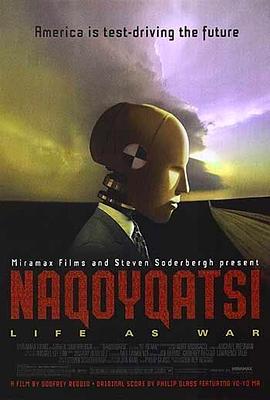
这是Qatsi记录片三部曲的最后一部。Qatsi是美国印第安土著Hopi语,意思是生活。 本片由于受资金困扰,2002年才得以发行,制作时间长达十年,但却没有象前面两部作品Powaqqatsi (1988)和Koyaanisqatsi (1983) 那样广受好评。 音乐仍然由Philip Glass操刀,马友友则在此片中担任大提琴独奏。 著名影评人ROGER EBERT说: “I have problems with Naqoyqatsi as a film, but as a music video it''s rather remarkable. (“Naqoyqatsi作为一部影片有不少问题,作为MTV倒相当出色。) 1983年,受IRS(Institute of Regional Study)委托,导演雷吉奥拍出了一部非叙事性的电视片,在这基础上,Qatsi系列第一部惊世之作《失衡生活》(Koyaanisqatsi)应运而生。在得到了包括卢卡斯、科波拉等人的大力支持与推广之后,《失衡生活》在当时形成了轰动性的效果。5年以后,Qatsi系列第二部《变形生活》(Powaqqatsi)诞生,尽管没有在第一部的基础上取得大的突破,但也不失为水准之作。 《战争生活》的诞生经历了许多坎坷。尽管《失衡的生活》与《变形的生活》都取得了相当好的评价,但在拍摄期间,导演仍然面临严重的资金问题。在这种情况下,尽管派拉蒙公司已经为前两部电影发行了DVD,但是雷吉奥仍然坚持收回版权,让想要购买DVD的影迷单独与他联系,单价150美金,作为对第三部影片拍摄费用的支持。最后在米拉迈克斯公司的支持下,由著名导演斯蒂芬·索德伯格(《性、谎言、录像带》,《毒品网络》,《永不妥协》)出任执行制片,历经10余年,终于完成了这部作品。 电影里充满着那些似乎无意剪接到一起的镜头,一会是冲天的原子弹,一会是变色的散发出奇异目光的多利羊,以及飘忽来去的世界地图,股票市场,数字,和人的游行……然后接着来了警察,以及挥舞的棍棒,长长的有刀的枪,还有飞过的子弹的呼啸……镜头一转,我们又看到了拳击手的攻击和倒下,本•拉登和胡子,还有变形的电脑,不停的毫无意义的争吵。接着还有什么?流动着噪音的和没有声音的阅兵,徐徐而进的汽车,布什,轮盘赌,云霄飞车,快餐,速度,网络……最后留下的是死亡,爆炸,而那些优雅环境里的键盘和字母在飞舞,汽车来了,光线亮了,车灯射过来,有人在哭泣……
Fleeing from their violent father, siblings Lucía and Adrián take refuge in a remote mansion. With the help of a hidden micro-camera on a cat, Lucía uncovers a terrifying secret: their neighbors are part of a criminal network that kidnaps teenage girls to make snuff films, and they intend to get rid of the siblings. As Lucía fights to protect her brother, she must face a dark family curse that follows them into their newfound sanctuary.
In 2013, an Australian man a few months shy of turning 60 decided to walk the Camino de Santiago – an 800km pilgrimage trail across the top of Spain. He had no known religion, and absolutely no idea why he felt so deeply compelled to do this torturous walk. But compelled, he was. He completed the walk, battling a “triumvirate of pain” - a knee that he later discovered lacked an...
Calvin Trask lives in a dead end Arctic town on the fringes of society, until mysterious stranger Lucas Wade arrives, turning his solitary life upside down. Calvin's curiosity gets the better of him and is quickly pulled into Lucas' dangerous world. As secrets slowly unravel, Calvin realises just what kind of jeopardy he's put himself in, a place where murder and betrayal are a...
In 2013, an Australian man a few months shy of turning 60 decided to walk the Camino de Santiago – an 800km pilgrimage trail across the top of Spain. He had no known religion, and absolutely no idea why he felt so deeply compelled to do this torturous walk.
But compelled, he was.
He completed the walk, battling a “triumvirate of pain” - a knee that he later discovered lacked any meaningful cartilage, a blister the sight of which would make a grown man weep, and shin-soreness that felt like his lower limb had been split with a mountain axe wielded by a demented troll.
Arriving at the end of the Camino, the majestic cathedral in Santiago de Compostela, he expected an epiphany – an answer to the question he’d been asking himself every day: Why am I doing this?
But no answer came.
So when he got home he wrote a book, hoping the answer would reveal itself in his scribblings. The result was The Way, My Way, a humourous and self-deprecating book that many consider the best memoir ever written on walking the Camino.
The book has now been made into a film, and it’s an extraordinary account of a man at a pivotal point in his life, searching for meaning and finding himself undergoing a fundamental transformation so profound that he now divides his life into “Before the Camino” and “After the Camino.”
It’s a story particular to one man, yet of appeal to anyone seeking a greater meaning from life.